
We continue our series of interviews with professionals who have remained loyal to Kuzbasskaya Toplivnaya Company JSC for over 20 years.
Dmitry Zharskis currently heads the logistics department and has firsthand experience of the company's growing and transforming coal transportation system. He joined JSC KTK as a supply department dispatcher in 2004, after graduating from the Kuzbass State Technical University.
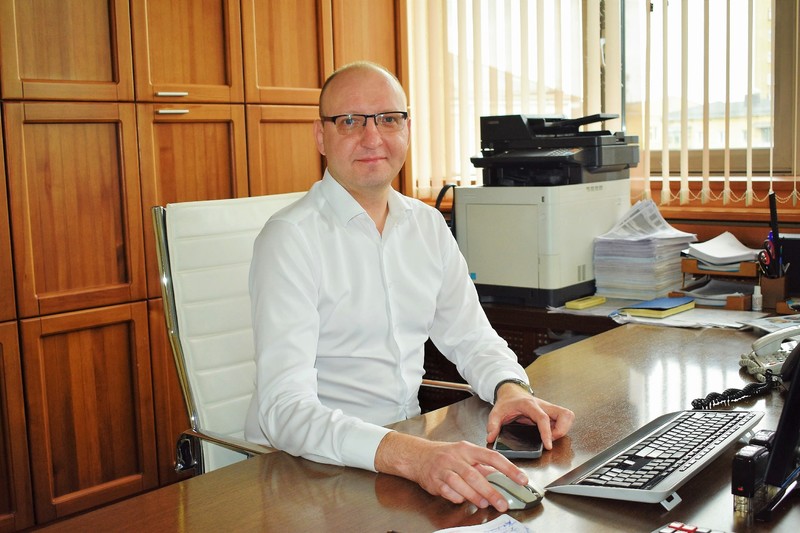
The Logistics Profession – How to Solve Daily Quests
"The dispatcher's responsibilities include coordinating all parties involved in cargo transportation from the manufacturer to the destination via rail tracks. The dispatcher checks for empty cars and resources for loading, and monitors the progress of formed freight trains. Today, our company has three loading areas and two processing plants. But 20 years ago, none of this existed. The infrastructure was just beginning to develop. Only one section of the Karakansky Yuzhny open-pit mine was in operation. The loading area was small, and it was fairly easy to get up to speed."
After a year and a half as a dispatcher, Dmitry was invited to join the transport department, which handled logistics.
"The main task of a logistician is to plan, organize, and deliver cargo to the end consumer."
SC KTK does not have its own fleet of railcars, so our specialists arrange for railcar rentals from rolling stock operators. We have signed cooperation agreements with almost all operators operating in Kuzbass, including service agreements with bilateral obligations.
In accordance with the monthly sales plan, we lease railcars, then create a loading schedule with the Meret Transport and Forwarding Company and track the delivery of cargo to destination stations. In the event of force majeure, such as train breakdowns or accidents en route, we decide on ways to minimize downtime and ensure on-time delivery of cargo. "Essentially, it's a dynamic, 24/7 operation," says Dmitry.
Logistics work has been modernized over the past quarter century. Now, specialists use various software services, which has significantly simplified the process of coordinating various documents and, consequently, reduced the time it takes to make logistics decisions.
"Previously, all freight transportation requests had to be certified with a stamp. This required almost daily trips to the Russian Railways office. Now, everything is coordinated remotely using software, and we have more time for other work. For example, at our company, the logistics department is tasked with monitoring not only the movement but also the quality of the transported resource. We track coal grades and shipment volumes at customer addresses. This additional focus broadens our horizons and allows us to become more deeply involved in the coal mining process. Therefore, our work is not a routine supply of wagons, but an interesting round-the-clock quest,” notes Dmitry Zharskis.
The art of balancing customer demands and company capabilities
As a coal company logistics specialist, it's crucial to be able to select suitable railcars! And there are many nuances involved.
"We have a wide geography of freight transportation. We have recipients in the Far East and along the Northern Railway. We also receive orders westward, to Kaliningrad, which can only be reached via Lithuania and the Republic of Belarus.
These countries impose stricter safety requirements on the condition of railcars. Wheelset wear is particularly critical. Therefore, when planning cargo delivery and assembling trains for international travel, logistics specialists ensure that railcars meet international standards. Otherwise, during inspection at the border station, defective wagons may be turned back, requiring a new recipient, customs clearance, and redirection—which means additional time and money spent on delivery.
It's also important to consider the type of railcars and the unloading methods at the customer's station. For example, the Belovskaya State District Power Plant has a railcar dumper, so solid-bottom railcars can be sent to this destination. These can also be used for unloading with a grab.
Customers who unload on elevated tracks unload through special hatches. And the most frequent requests are for cars with hatches. However, the trains we receive from operators include cars of various types, and we need to load them as quickly as possible. It's safe to say that logistics professionals balance railcar availability with customer delivery demands every day. Profitability is paramount! Different operators may charge different railcar rental rates for the same route. Our job is to choose the lowest."
It is worth noting that the logistics department systematically handles claims.
"Every wagon owner has their own terms and conditions for their use. For example, downtime for loading and unloading should not exceed two to three days. On the other hand, buyers also have similar requirements.
If JSC KTK delays a railcar on its internal tracks for more than two or three days, the operator has the right to issue a fine the following day. Our company, in turn, has the right to impose fines if the buyer delays unloading.
Our claims specialist systematically inspects each car and determines the circumstances of the downtime to minimize losses," says Dmitry.
Without monotony, with a passion for logistics.
Today, Dmitry Zharskis, along with 13 people, works in the logistics department of JSC KTK. And the key characteristic of all of these specialists is their flexibility of mind and the ability to take decisive action.
"In our business, commitment to the work and a willingness to make independent decisions based on the evolving situation are essential. Simply loading for the sake of loading is not our style. We seek optimal solutions, and every specialist in their role actively contributes to a successful outcome. A specialist in their position makes an active contribution to a good result."
When asked about his personal experience and the reasons for remaining faithful to his chosen professional path, Dmitry replies:
"My work has never been monotonous. And I like it. By the time a train car reaches its destination, anything can happen: it can derail, swell, or capsize... And each time, solving the problem that arises is a challenge and a test that broadens horizons and enhances professionalism. And even after working your way up from a simple dispatcher to a department manager, you become attached to your work. You perceive it as an important and natural part of your life, without thinking about where things could be better."

